Cookie Queens Review: This Doc Never Crumbles
POV
01/31/2026
Back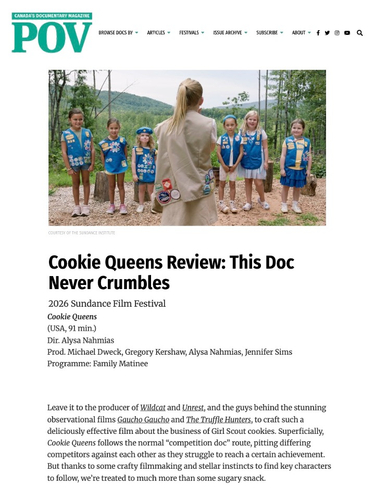
by Jason Gorber
2026 Sundance Film Festival
Cookie Queens
(USA, 91 min.)
Dir. Alysa Nahmias
Prod. Michael Dweck, Gregory Kershaw, Alysa Nahmias, Jennifer Sims
Programme: Family Matinee
Leave it to the producer of Wildcat and Unrest, and the guys behind the stunning observational films Gaucho Gaucho and The Truffle Hunters, to craft such a deliciously effective film about the business of Girl Scout cookies. Superficially, Cookie Queens follows the normal “competition doc” route, pitting differing competitors against each other as they struggle to reach a certain achievement. But thanks to some crafty filmmaking and stellar instincts to find key characters to follow, we’re treated to much more than some sugary snack.
The annual sales drive of Girl Scout cookies is the central funding scheme for this storied organization, resulting in over $800 million dollars of revenue annually. In the U.S., some 200,000 young girls are set out to achieve their stated goals, trafficking the likes of Thin Mints, Lemonades, Trefoils and Do-So-Dos to members of the community. Standing in the cold outside grocery stores, wandering the aisles of flea markets, or using the tools of social media, e-commerce, and even broadcast television to hawk their wares, the cookie drive is, on the one hand, an exercise in developing entrepreneurial skills, and on the other hand, an explicit example of child labour exploitation.
What elevates Cookie Queens are the perspectives of four kids from various backgrounds who thrive and struggle with these cookie conundrums. The film isn’t some shiny celebration, nor is it a dour excoriation of the practice. Instead, it’s a terrifically nuanced look at this formative experience for these young people, belying any preconceived expectations of what’s to transpire as they set out on their sales goals, while still allowing central questions and concerns to be raised throughout.
We meet Olive, a legendary salesperson who, at the age of twelve, is already a veteran in the game. A record holder for her region, we see as she creates a slightly modest goal of 5,000 boxes sold (still almost double the other members of her troupe), and sets about making things happen. Assisted by her parents, she has the tenacity and slightly manic approach of a young Tracy Flick from Alexander Payne’s comedy Election, and one could easily see this mode of entrepreneurial intensity mocked in other circumstances.
Yet Olive is well aware of the pressures to achieve, both from within and without, with the responsibilities buttressed by the drive to upsell to her prospective clients. The blasé way she receives constant compliments of being such a “good little sales lady” shows how much of the work has become rote. At the same time, there’s a clear drive to add another record to her list of achievements.
We’re introduced to Nikki as she watches her older sisters Nyah and Nala as they rehearse for their latest TikTok dance video. She peeks around the corner but isn’t invited to participate in the fun. The elder siblings are all former champion sellers in Chino, California, and Nikki is in a position to make a mark of her own. The goal for them is to sell enough cookies to warrant a trip to Europe, and it’ll take many trips in the family’s Cadillac SUV to be selling rain or shine to make this dream a reality.
We then travel to El Paso, Texas to meet Shannon Elizabeth, an eight-year-old whose dream is simply to attend a summer camp. Her parents are of lesser means than the others, but together as family, they take a real financial risk in order to foster their daughter’s dream. Part of the mechanism of these sales is that parents must pre-buy the inventory, meaning that success or failure to achieve sales goals can have real lasting consequences on those without the income to regularly gamble on such ventures.
Finally, there’s Ara, a precocious five-year-old with the modest goal of 50 boxes sold. Traipsing on the California beaches with her red wagon in tow, she exudes warmth and joy while trying to share sweets with strangers. A small device to regulate her insulin levels is attached to her arm, making the selling of sugary snacks a slightly ironic practice. Here too the film deftly injects a small amount of critique in showing how inclusion only goes so far within the massive process of the cookie game.
Executive produced by Harry and Meghan, the Duke and Duchess of Sussex, the film has the markings of something major, primed to be embraced by the millions who have either sold these cookies themselves, or simply have partaken of the treats on an annual basis with attention gained from the royal imprimatur. Yet Nahmias’ deft storytelling sets the film apart from any celebrity endorsement, beautifully navigating the various complexities without ever losing its sweet appeal.
Cookie Queens is one of those terrific works of non-fiction that explores a microcosm only to uncover far broader social and political factors that emerge from what otherwise would appear to be a minor cultural event. Emotionally rich, terrifically paced and handsomely framed, this is an exceptional work that’s greater than its ingredients, sandwiching politics, commerce, and the joys of childhood all into one package.
Cookie Queens premiered at the 2026 Sundance Film Festival.